Research
Working Papers
Technology M&A and Knowledge Diffusion (Job Market Paper)
Abstract: This paper examines how technology mergers and acquisitions (tech M&As) affect the diffusion of target firms’ pre-acquisition innovations in the United States. Using US patent and M&A data from 1980 to 2021. This study employs a difference-in-differences approach comparing successful acquisitions with exogenously failed deals; it finds that tech M&As significantly increase external diffusion of targets’ technologies, as measured by patent citations, with effects concentrated within the acquirer’s industry. Tech M&As do not diminish young firms’ ability to cite and build upon acquired targets’ patents, contradicting concerns about innovation foreclosure. To interpret these findings and quantify aggregate implications, I develop an idea flow model where firms improve productivity by choosing innovation intensity based on potential targets’ technologies, with acquisitions affecting both the innovation step size in learning from targets and the cost of accessing them. The model, calibrated to the empirical estimates and US innovation data, reveals that doubling the 2015 tech M&A rate would increase annual productivity growth by five hundredths of a percentage point, with the diffusion channel contributing 40% of this increase. Surprisingly, relaxing restrictions on post-acquisition knowledge appropriation yields negligible growth effects: reduced spillovers from acquired targets are offset by increased innovation using independent technologies as acquisition values rise. These findings underscore the importance of incorporating diffusion effects and general equilibrium forces into antitrust policy for tech M&As.
Open Innovation and Ecosystem Disruption: Evidence from Tesla’s Patent Pledge
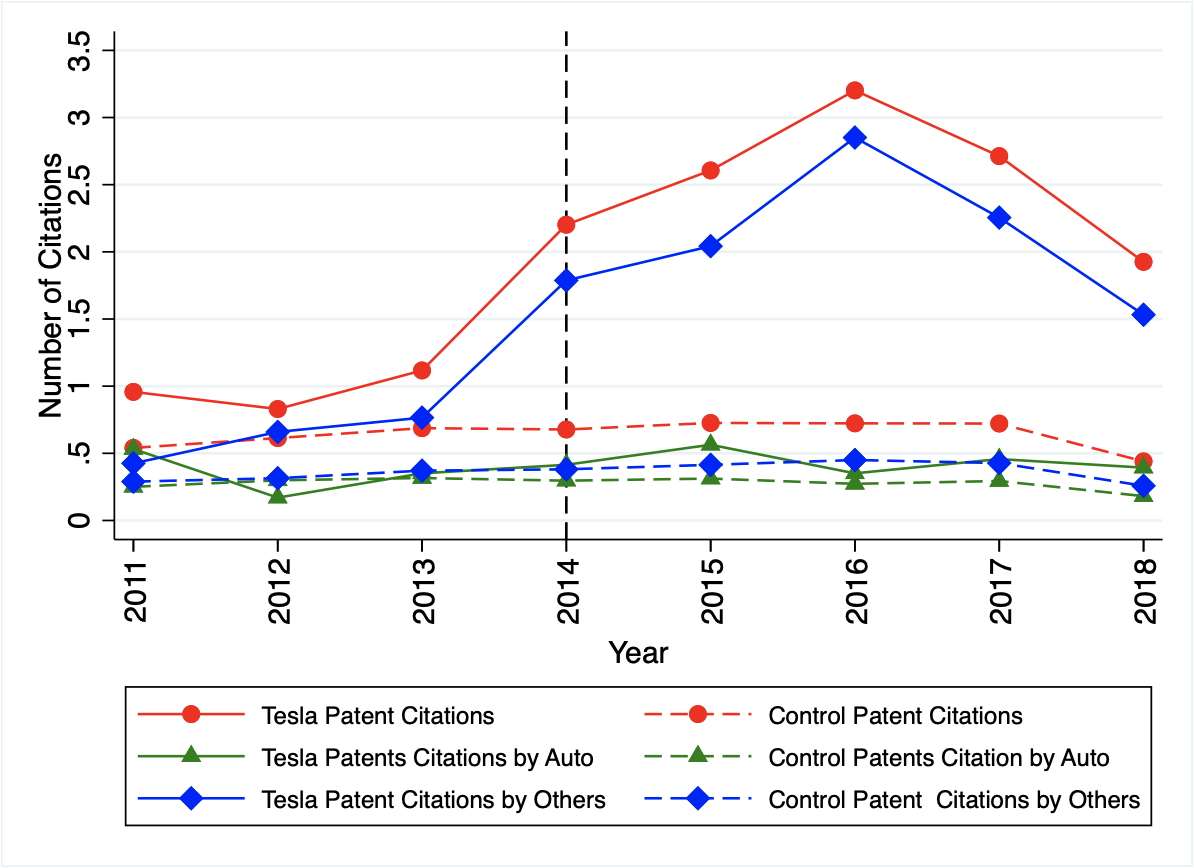
Abstract: We examine the causal effects of Tesla’s unprecedented 2014 patent pledge on innovation diffusion and ecosystem development in the electric vehicle industry. Using a difference-in-differences design that compares citations to Tesla’s pledged patents versus similar control patents before and after 2014, we find that the pledge significantly increased follow-on innovation by 70% overall. However, this effect is entirely driven by firms outside the traditional automotive sector—particularly battery and electronics companies—while incumbent automakers showed no significant response. The results are strongest for Tesla’s battery technologies, which experienced a 218% increase in citation rates from non-automotive sectors post-pledge. Our findings suggest that patent pledges can effectively accelerate cross-sector knowledge diffusion and ecosystem development, but their impact depends critically on the competitive dynamics between pledge-making firms and potential adopters. These results have important implications for innovation policy and corporate strategy in emerging technology sectors.